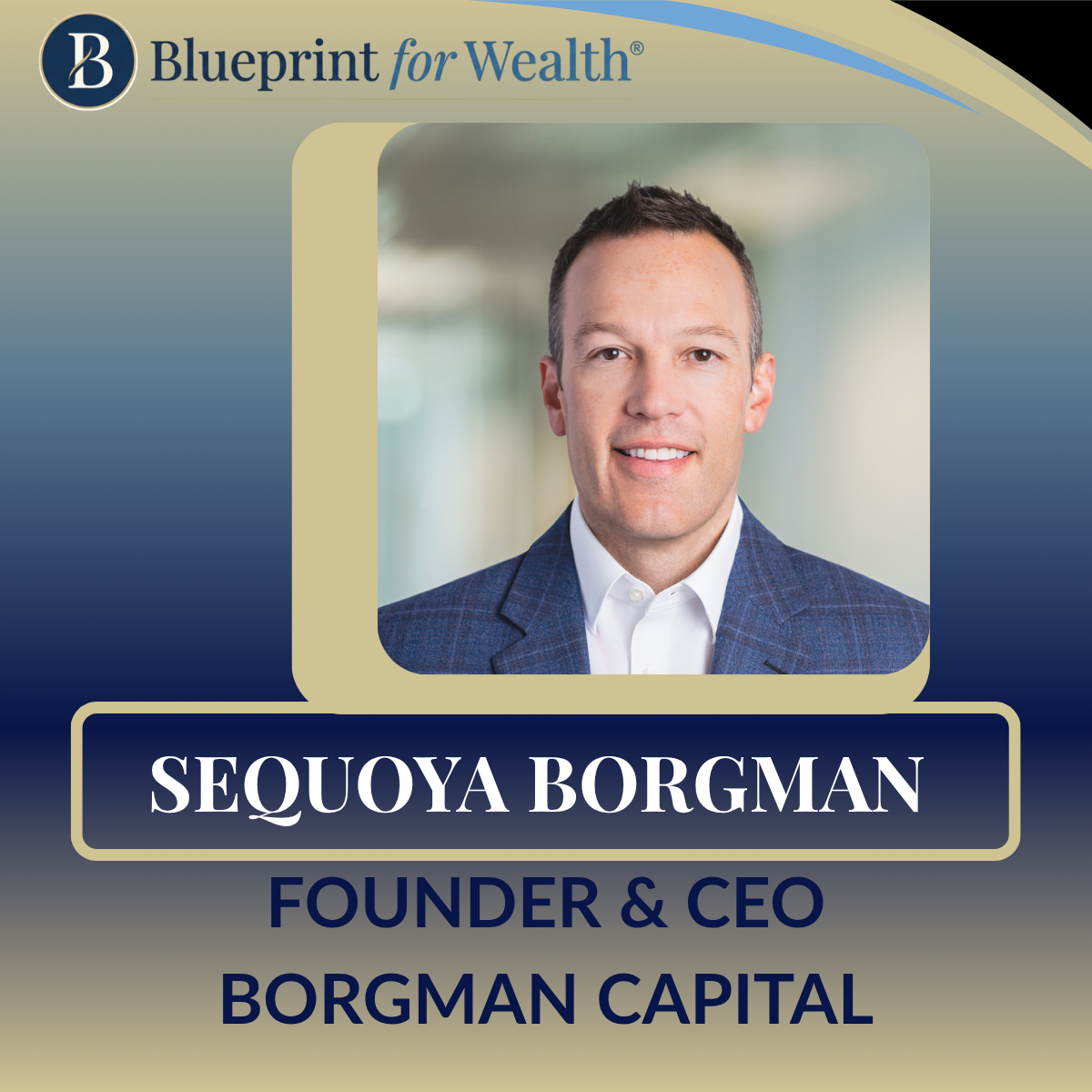
Lower Middle Market Sourcing, Investing, and Value Creation
On this episode of Sutton Capital: THE INVESTOR Podcast, host Joel Palathinkal speaks with Sequoya Borgman, Founder and CEO of Borgman Capital. Drawing on his 18-year background in public accounting and transaction advisory, Sequoya outlines Borgman Capital's focus on value investing across lower-middle-market manufacturing, distribution, equipment dealerships, and food businesses.
The conversation offers practical insight for business owners, investors, and M&A professionals into how established closely held companies are evaluated and acquired. Sequoya details why seller trust is a primary quantitative and qualitative filter, how professionalizing infrastructure drives long-term value, and why investors must maintain discipline when building a sustainable middle-market portfolio.
Listen to the conversation to hear Sequoya's approach to deal sourcing, seller alignment, and leadership transitions.
Key Takeaways
Value Investing Requires Focus on Cash Flow and Proven Business Models
Borgman Capital targets established industrial, manufacturing, distribution, equipment, and food businesses, often with 50- to 70-year operating histories. These companies typically fall into a sweet spot of $4 million to $8 million in EBITDA and $20 million to $150 million in top-line revenue. Acquisitions of this size remain beneath the most aggressive investment banking auctions while ensuring steady cash flow capable of servicing debt through economic cycles.
Seller Trust and Cultural Alignment Are Prerequisites for Deals
The primary condition before moving forward with a deal is mutual trust between the buyer and seller. Borgman Capital seeks sellers who care about their company, employees, and community, as these businesses perform significantly better after a transaction. Maintaining seller involvement through rollover equity, board seats, or a multi-year transition helps preserve company culture while securing executive alignment.
Value Creation Stems from Professionalization, Not Turnarounds
Borgman Capital avoids broken business models or distressed companies. Instead, the firm acquires healthy family- or founder-led businesses and performs the heavy lifting necessary to transition them to institutional readiness. Value creation comes from installing operational systems, establishing standard processes, introducing professional management teams, and modernizing operations to position the business for its next stage of growth.
Intellectual Curiosity Matters More Than Financial Modeling
While financial modeling is a necessary baseline skill for investors, it is not enough. Because every business model and organizational culture is distinct, successful buyout managers need deep intellectual curiosity. Effective investors must be constant learners who take the time to talk with founders, research target industries, understand how a business actually generates profit, and identify operational risks.
Questions Addressed in the Conversation
What sectors and financial criteria define Borgman Capital's target investment profile?
Borgman Capital targets lower-middle-market industrial businesses, including manufacturing, distribution, equipment dealerships, and food manufacturing or packaging companies. The firm focuses on established businesses generating between $4 million and $8 million in EBITDA and $20 million to $150 million in top-line revenue.
How does Borgman Capital approach artificial intelligence and technology adoption in its portfolio?
While Borgman Capital encourages internal team and portfolio usage of AI for administrative, back-office, and sales workflows, Sequoya notes that measurable ROI in physical lower-middle-market manufacturing remains in its early stages. Technology adoption must be practical and evaluated against concrete returns before implementation.
What advice does Sequoya offer emerging fund managers building a track record?
New fund managers must focus on a defined investment thesis and niche rather than pursuing transactions simply to deploy capital. Given tighter liquidity and capital aggregation among larger managers, emerging investors must maintain underwriting discipline and focus on sectors that yield reliable returns.
From the Conversation
“Do what you say you’re going to do. Do the right thing. If things don’t go as expected, just make it right.”
-
This transcript has been edited for clarity and readability. Please refer to the original podcast recording for the complete conversation.
Joel Palathinkal: Welcome to The Investor, a podcast where I, Joel Palathinkal, your host, dive deep into the minds of the world's most influential institutional investors. In each episode, we sit down with an investor to hear about their journeys and how global markets are driving capital allocation. So, join us on this journey as we explore these insights.
Joel: I'm super excited to have another episode of The Investor Podcast. I'm really excited to have our guest today, Sequoya Borgman. He's the Founder and CEO of Borgman Capital, an investment firm specializing in acquiring majority interests in well-established, closely held lower middle-market companies.
This is a role he's held since October 2017, with more than two decades of experience in M&A, including structuring, planning and due diligence. Sequoya brings extensive expertise to the firm.
Before founding Borgman Capital, he was a partner and practice leader at RSM, a leading multinational accounting firm. Before that, he was a managing director at KPMG. Throughout his career, he's advised on numerous complex transactions for both public and private-market firms.
A lot of that experience, I'm assuming, has helped him build an institutional firm. He holds master's and bachelor's degrees in accounting from East Carolina University and is a certified public accountant. He also actively contributes to the community by serving on the boards of public companies, private companies, nonprofit organizations and professional associations.
Sequoya, thanks for coming on. Hopefully that was a good high-level introduction. I'm excited to go further and dig deeper.
Sequoya Borgman: Yeah, I appreciate you having me on the show. I think you hit all the high points.
From Public Accounting to Private Equity
Joel: There are a lot of other points that I think are going to add a lot of color. What I always like to do is learn a little more about your early career.
Having that accounting foundation is a really great foundation, and oftentimes we see people move to the fund administration side or the fund audit side. It's really interesting to see you move over to the buy side.
Walk me through your early career, what you thought you were going to do in college, how that eventually evolved into getting into the buy side, and ultimately building your own investment firm supporting middle-market private equity.
Sequoya: I think it's a little unique coming from the CPA and accounting side. Most people in private equity started in investment banking and then moved over to the investment side.
I originally was a finance major in undergrad. When I was coming out of school in the late '90s, there were a lot of roll-ups in the banking sector, states were deregulating banks, and there just weren't a lot of jobs in the finance sector. So I transferred over to accounting, got my master's in accounting, and started out with Arthur Andersen, which at the time was one of the largest firms in the world.
It was a great place to start my career. With any of those big organizations, you really can't beat the training.
I spent 18 years in public accounting. That's where I got introduced to the deal side and transactions. I worked on a lot of large international and national acquisitions and mergers.
Towards the end of my career, I joined RSM. That's where I really got introduced to the lower end of the middle market and a lot of the middle-market firms doing deals.
I'd been a partner for a long time and was ready to do something a little more entrepreneurial. That's why I launched the firm almost a decade ago, really investing in these nice lower middle-market companies all around the country.
Investing in Established Businesses
Joel: What are some of the sectors that you like getting involved in? We see a lot of people getting into home services, HVAC and plumbing. Do you feel there's a lot of opportunity in those sectors, or are there other sectors where you feel more comfortable being a market leader?
Sequoya: The service sectors are very popular right now. Everybody's a little concerned about AI and thinks residential and commercial services are a good space to be in.
We tend to stay away from those businesses, though. Those are really people businesses and all about the leaders. It's a very high risk if you don't have the right person running those organizations and doing the integrations on the roll-up.
We tend to be more value investors. We're investing in older industrial businesses, more manufacturing and distribution. We've bought a couple of equipment dealers and quite a few food businesses. We've done well in those spaces.
They're more established businesses—family businesses and entrepreneur-led businesses that have been around 50, 60 or 70 years and have an established business model. Maybe there's more of an older industrial focus, but at the end of the day, we're value investors.
We're buying these types of businesses that aren't getting the double-digit multiples like some of the sectors that are hot.
Targeting the Lower Middle Market
Joel: What type of ARR and EBITDA do you like to get into? Walk us through a typical deal that hits the sweet spot for you.
Sequoya: Our sweet spot is the lower end of the middle market. I'd say between $4 million and $8 million of EBITDA is probably the majority of our deals.
We've done some bigger deals, up to $15 million or $16 million of EBITDA, and we've done a couple under $4 million. But I'd say you want a business with a little bit of decent size while staying under the really competitive professional investment-banked auction processes.
Once you get to $10 million or $15 million of EBITDA, those are just a little more competitive than what we want to spend time on.
Joel: So when you think about $4 million to $8 million in EBITDA, you're probably thinking at least maybe $25 million to $50 million in top-line revenue?
Sequoya: I'd say at least $20 million in top-line revenue. Somewhere between $20 million and $100 million to $150 million is the majority of our businesses.
Investing in Food Manufacturing and Packaging
Joel: The food businesses are interesting. What types of businesses do you like in food and family-owned businesses? Are they catering companies, restaurants, or more mass distribution of food to restaurants?
Sequoya: They're primarily manufacturing or packaging businesses in the food space.
We've got five offices around the country, but our main office is here in Milwaukee, Wisconsin. So, if you're in Wisconsin, you have to have some investment in the cheese space.
We own a cheese company, and that's been a great investment for us. It was owned by a husband and wife—a closely held business that had grown to a nice size and was looking for an exit. It was just a perfect fit for where we invest.
What Makes an Attractive Investment
Joel: What do you look for when you're thinking about acquiring one of these types of businesses? On the qualitative side, what are some things you check the box on when you're looking at the founder or family that's eventually going to support the transition? Outside of the financial metrics, what else do you look at in terms of whether it's a healthy business?
Sequoya: Well, you said I have the accounting background. We're pretty conservative, so the numbers are the number one thing.
We look at about 1,500 businesses a year to buy two, three or four businesses. It really has to have strong cash flow. We're a traditional leveraged buyout model, so the business has to be able to service that debt.
It can't be overly cyclical or have cash flow that you can't really rely on. Those types of businesses we pass on.
But if it's steady, has a proven business model and a good management team, those are businesses we dig into.
The number one thing before we go forward is really trust between the seller and us. We want a seller that really cares about their company, cares about their employees and cares about the community.
Those companies tend to do better after a transaction once we get involved. We really have to be aligned with that seller and know that they want what's best for the business. If that's the case, those are the types of businesses we really pursue.
What Makes a Great Investor
Joel: What would you say are some of the qualitative and quantitative skills that make a good investor, especially if you're looking to hire somebody to expand your team? What are the qualities of a good buy-side manager?
Sequoya: The analytical side is key, but there are a lot of people with good analytical skills.
I think somebody with intellectual curiosity is important. Every business is different. Every culture is different. Every business model is different.
You really have to sit down and understand how that business makes money, where its value is and where value creation can be added.
That takes somebody who's a constant learner—someone who's intellectually curious, enjoys talking to business owners and management teams, really digs in, does the research and reads whatever is required to understand that sector and that business.
I think that's more important than the analytical skills, which, like I said, a lot of people have. They can do the modeling all day long.
But truly understanding the risks in a business is key.
The Role of AI in Private Equity
Joel: We've had several middle-market and larger buyout firms on our podcast, and a lot of them have started talking about using AI. Some have gone as far as replacing an analyst with AI to put together a memo very quickly.
I'm assuming there's probably some of that going on because you told me you talk to 1,500 companies and screen them. Where do you see AI fitting into your sourcing, screening and technology stack to augment some of your workflows?
Sequoya: Like everybody, we've definitely been spending a lot of time focused on AI and encouraging the whole team to use it as much as possible.
We've got quite a few tools in place at this point, and there are some tools that will take on some of the analytical and lower-level skills.
It's not perfect. We haven't replaced anybody. It's made everybody's roles and jobs more streamlined and easier.
Personally, it's freed up some of my time to really focus on bigger-picture and higher-level strategy.
But I haven't seen any real value creation at this point. We've been encouraging the portfolio to use it quite a bit, and there are some areas where it's good at quoting and some of the back-office and sales portions of the business.
But I haven't seen any real return on those investments. I think we're a little early, at least in our sector.
I think some of the more technology-focused businesses are getting a better return, but in older industrial and manufacturing businesses, I think it's coming. I think in the next 12 to 24 months we'll start to see some returns on those investments.
The Future of Manufacturing, Robotics and Physical AI
Joel: Where do you see the future of manufacturing heading? With the investments you've made, do you see technologies that are going to streamline some of those processes?
Sequoya: Manufacturing has had a lot of focus on automation, robotics and AI for years, so I think it's a slower process.
I think manufacturing will probably be one of the last places where AI really takes over once some of this new robotic technology is pushed down into the lower middle market.
It's being used now at companies like Amazon, but it takes a while to really roll downhill to where you have to get a return on that investment.
If we're paying 10 times for a business, you spend a dollar, you need $10 to get a 10-times return on that dollar. That's kind of where we're at right now. The costs just haven't aligned to this point.
Joel: One of the craziest things I've seen recently was a robotics company renting several Airbnbs and bringing in robots to train them on models to do home tasks. These Airbnbs are getting damaged in the process, but the companies are paying the costs because they're effectively creating a large-scale environment to train the robots.
For me, it's been interesting to think about physical AI and how people like Jeff Bezos and Travis Kalanick are building businesses around integrating AI into the physical world.
Sequoya: I think it's an interesting space for sure. I just think it's going to take a lot longer in the 3D world.
White-collar roles, engineering and programming have data available for AI to train on. But going and making a bed or folding laundry—that kind of stuff—each robot has to be trained to do each process.
Once you train the robot, though, every robot has that same knowledge.
It's no different from autonomous cars. That's taken a lot longer to come to market than anybody thought. Ten years ago, everybody thought there would be self-driving cars all over the roads. It's coming, but each road, each turn and every situation has required a lot of training.
All of these physical roles, factory roles and manufacturing roles have to be trained. At some point they will be there, but I'm not sure if it's a year out or 10 years out.
Advice for New Fund Managers
Joel: Another thing that I think would be really helpful is your advice for new fund managers who are trying to pivot into asset management from another discipline.
Talk to us about how you build a firm. I'd assume you'd want to build some of those skills, learn how to be an investor at a firm and get some work experience. But how do you shift your mindset from being an employee or an investor to becoming a fund manager managing capital?
Sequoya: Right now, it's difficult. Fortunately, when I launched in 2017, it was a great time to raise capital. There was plenty of liquidity out there and a lot of money going into private equity.
Times have changed. It's a lot more difficult now. A lot more of the capital is getting aggregated among the very large fund managers. There's less liquidity, so a lot of LPs are not supporting new fund managers.
But for good investments, everybody's always looking for good investments.
You really have to have a great investment thesis. You really have to have a niche. If you do that, it may take longer to raise the capital than it did in the teens or 10 years ago, but there's always money available for good investments.
That's the main thing: make sure you focus on an area where you can get the returns and build up that track record.
Differentiating as an Investment Firm
Joel: How do you differentiate yourself? If you're a middle-market private equity fund manager, what are some ways you've seen help firms stand out and make that story resonate with LPs?
Sequoya: The most successful ones have really focused on one niche or one segment that has done well. Timing and being in the right place at the right time really helps.
We've been more of a generalist and opportunistic. Our focus is really more on these nice, established, cash-flowing family businesses than any one industry, segment or geography.
We'll go wherever the deal is, wherever it is in the country.
I think that's been successful for us. We've got a 10-year track record and have had some very successful exits, so that helps at this point.
But when you're first starting off, it's hard. My first couple of deals were very difficult. You've just got to be successful on those.
As a new fund manager, you've got to make the right investments. Don't just buy what's out there because you want to get a deal done. You still have to be very disciplined and selective about what you go after. I think that's key.
Professionalizing Founder-Led Businesses
Joel: You talked about integration. When you acquire a business, how much of a lift do you typically have to add? Do you like to come in when it's already humming and there isn't much to optimize, or do you like to make changes and really optimize and increase EBITDA over time?
How much of a turnaround do you like to take on with the investments you're making?
Sequoya: We don't do turnarounds or restructuring or anything that's really a broken model that we have to fix. We're just buying nice companies.
But those family businesses we're buying all have to be professionalized. You have to put systems in place, bring in professional management, put processes in place, and do a lot of the heavy lifting to get it ready for the next level of firm that really doesn't want to roll up its sleeves and invest that time and energy.
That's our value creation.
Joel: So there still is that involvement. I guess you could call that the integration, where you come in and add a lot of those systems, automation and modernization to get it to the next tranche of EBITDA and hopefully get you that serious DPI at the company level. The company-level performance is going to drive the fund-level returns with the value creation, I'm assuming?
Sequoya: Yeah, that's a lot of the value creation at our level.
The biggest risk is transitioning from a family- or founder-owned business to more of a professional management team. A lot of investors don't want to take that risk.
We'll do that. We'll make sure that transition goes smoothly, and we'll sell to maybe a bigger fund, a strategic buyer or a public company that already wants something where all of that heavy lifting has been taken care of.
Managing the Founder Transition
Joel: What are some of the challenges and processes that you've built to address that specific issue—transitioning from a family to building a professional team?
I'm assuming it's SOPs, but how long do you like to have the family still involved to help with that transition?
Sequoya: It kind of depends on the transaction, but we like to have them still have skin in the game. We want their interests aligned with ours.
A lot of times they'll sit on the board and be involved even after they transition. A lot of times they'll stay around for a year or two and run the business and help us pick the right successor.
We like it when they want the company to continue to be successful and thrive. That's really our focus.
We try to work with the sellers as much as possible because we know that is the risk. The risk is bringing in the wrong president or the wrong leader of that business—either they don't fit culturally or they just don't have what it takes to run that business.
Thinking About the Exit
Joel: When you think about the exit, it's interesting how you're already thinking about the acquirer or the business. How can buyout firms really think through mapping that out as they acquire the business? How can you think through different options for getting to liquidity and having a healthy multiple?
Sequoya: We try to run the businesses like we're going to own them for the long term.
You make the investments as if these businesses were built over 50 or 100 years. They don't turn around in a year or two years. Sometimes they do and you find some good levers to pull, but that's more the exception than the rule.
And you can't time an exit. Right now is not a great time for exits. There are a lot of people that bought companies in 2020, 2021 and 2022 that would love to be exiting right now. That was probably part of their business plan, but you can't really exit in a down market or where there aren't a lot of opportunities.
You have to run the business as if you're holding it for a long period of time.
Our number one priority is to do whatever is in the best interest of our LPs and investors. We usually exit when we're really exceeding our investment thesis in that business and it's going to be a really nice return, or when somebody—or several potential acquirers—reach out to us.
We know that means it's a good time to exit that business, and we'll hire an investment banker and go through a process.
Sourcing and Investment Committee Discipline
Joel: As you are screening these 1,500 companies, can you walk through at a very high level how you prioritize and decide which ones go to investment committee?
You probably have a huge database and a checklist of criteria, but what is it about the business that shortlists them to finally make it to IC? And when you go to IC, I'd love some guidance on best practices to hold an IC and make that final decision because there's a limited pool of capital and you really have to make sure you're making the right decision.
Sequoya: There is a limited pool of capital, but it is also very competitive.
The best companies have plenty of buyers. We sold a company earlier this year, and I think we had 40 bids for that business.
I tend to spend my time on something where I feel like we have an angle or something where we have a higher likelihood of winning that process or really connecting with the seller.
That's probably the number one thing. We probably talk about 10 or maybe 20 businesses a week, and the ones I spend the most time on are those where I feel like we have a higher likelihood of winning.
If there's only a 1% chance of winning, I don't want to spend a couple of days visiting that business, spend $5,000 on travel, hotels and dinners, and all that kind of stuff if there's really little likelihood that we're going to win.
First off, it's got to be something that we like and that meets our cash-flow and financial metrics. But also, there needs to be a likelihood that we have an angle where we can win.
Building a Strong Deal Pipeline
Joel: What are some of the best pipelines for deal flow? I know a lot of people focus on relationships. Are there trade shows or online databases that you think are great for building these pipelines with great portfolio companies?
There are a couple of databases out there that you can subscribe to, but what's worked for you in terms of getting access to the best deals?
Sequoya: I think the best deals come through our network—where somebody introduces us.
We've got five locations around the country, and I feel like it's key to sit in those markets where your friend introduces you to somebody who wants to sell their business, or your financial advisor or some center of influence introduces you.
Those are the best opportunities.
Every person on our team—we've got 15 people—is incentivized to do cold outreach and work all the trade shows and industry shows.
We hire buy-side brokers to do searches. We use marketing firms, a lot of SEO, the podcast like this.
This really helps get the name out there. I get a lot of people reaching out to me through LinkedIn who want to sell or know somebody who wants to sell.
You really have to do a little bit of everything to find good opportunities.
Final Advice
Joel: Sequoya, I appreciate all the good work. I'll definitely share all the good work with our community on all of our channels.
I always end every podcast with one piece of advice. It could be from an advisor, a mentor or a family member, and it doesn't have to be professional. It could just be about life advice. Whatever you have for us, we'll take that back with us.
Sequoya: One thing I tell my team quite a bit—I don't know where I first heard it—is just: do what you say you're going to do. Do the right thing.
A lot of people's livelihoods and their families rely on us—hundreds and thousands of people.
At the end of the day, do the right thing. If things don't go as expected, just make it right. I think that's a good philosophy to live by.
Joel: Great advice. We learned a lot, and so will our community.
Thank you so much, Sequoya, and everybody else, have a great weekend.
Sequoya: Thank you. Have a good weekend.
Joel: Take care. Bye-bye.