
Buying Family Businesses & Preserving Culture: How To Invest In A Family Owned Business Without Losing What Made It Work (Podcast)
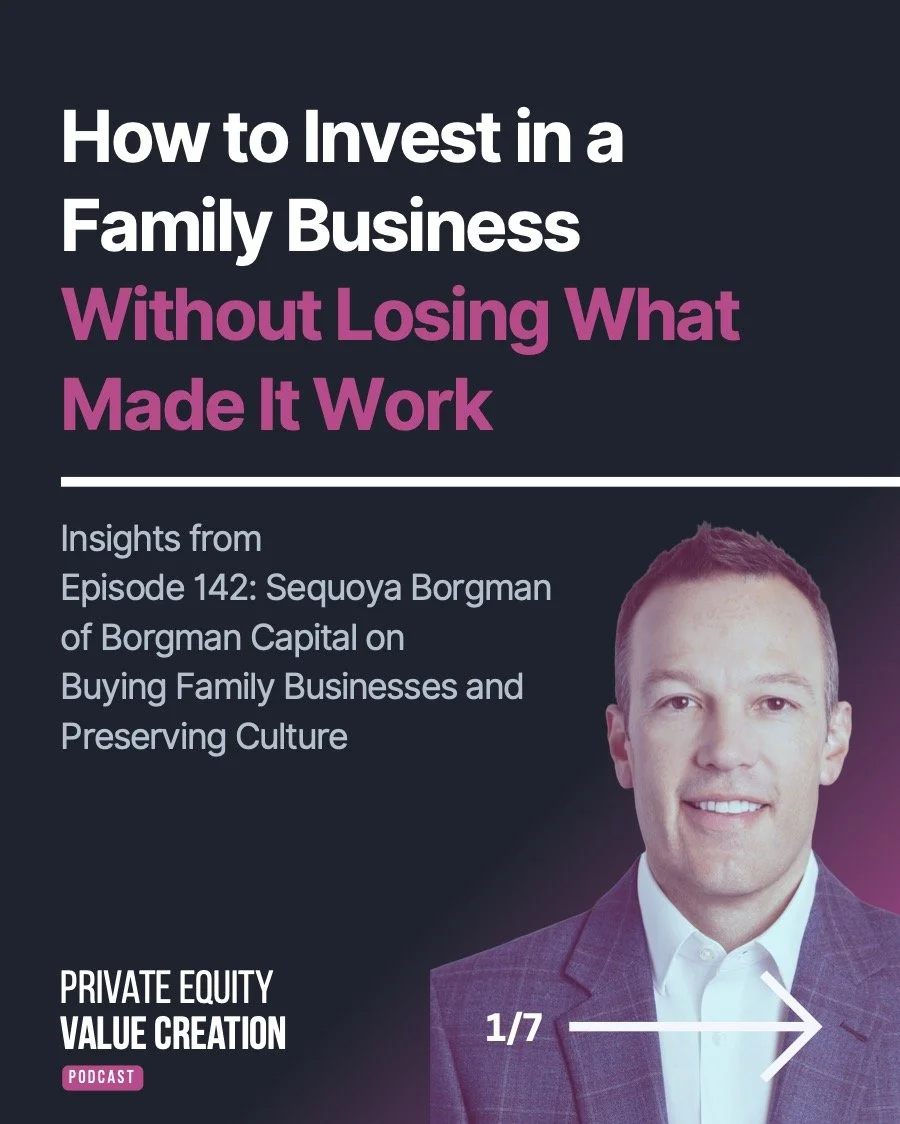
On this episode of the Private Equity Value Creation podcast, host Shiv Narayanan sits down with Borgman Capital Founder & CEO Sequoya Borgman to discuss how the firm has built a distinctive lower middle market investment platform focused on family- and founder-led businesses. Sequoya shares insights into Borgman Capital's long-term hold strategy, their disciplined approach to capital allocation, and why prioritizing company culture, employee well-being, and community impact is central to driving sustainable value creation and business continuity. You can also listen on Apple or Spotify.
The conversation offers an inside look at:
Why We Prefer Steady Cash Flow Over Trendy Tech Startups
Holding Onto Great Companies for the Long Haul
How We Partner with Over 500 Individual Investors
Passing the Torch While Protecting the Founder's Legacy
Upgrading Systems and Finance Without Overwhelming the Team
Keeping Businesses Safe During Unpredictable Markets

-
This transcript has been edited for clarity and readability. Please refer to the original podcast recording for the complete conversation.
Introduction and Overview
Shiv Narayanan: Hey, everybody, before we get started with today's episode, I want to take an opportunity to tell you about my new book, AI Marketing Blueprint. It just hit number one bestseller status across multiple categories on Amazon, and it walks you through a proven framework that we are taking our clients through here at How to SaaS on how to stay relevant and visible in a world with AI platforms. One of the biggest problems that we have seen across clients and companies is that the traditional channels that they relied on, like paid search or SEO, have declined significantly or are getting more expensive and competitive.
The reason for this is that a lot of buyers are starting to self-educate and research on AI platforms, so a lot of that volume that was previously going to those channels is now moving to these new AI platforms. To stay relevant, the book walks you through seven new rules that companies in all kinds of verticals and industries need to consider so that they can continue growing their pipeline and revenue and ultimately their enterprise value. So if this applies to your business or one of the companies that you've invested in, I definitely recommend that you pick up a copy. It's available on Amazon, Apple Books, and Barnes & Noble. Share it with your teams, grab a bunch of copies so that you can consume the content together and start to apply it to your business.
With that said, let's move on to the episode. Welcome to the Private Equity Value Creation podcast, where we interview leading investors, operators, bankers, and advisors to help you answer one question: how do we increase the enterprise value of our companies? My name is Shiv Narayanan and each episode I will dive deep with a guest to help you become a better value creator and capital allocator.Let's jump right in and get started with today's episode. My guest today is Sequoya Borgman, founder and CEO of Borgman Capital. What I really enjoyed about this conversation is, one, Borgman invests in companies that are very different from most private equity firms. They invest in manufacturing and a lot of other legacy industries as well. I really appreciated Sequoya's approach in terms of how they look at buying and holding these companies, while simultaneously focusing on the cultural side and the people side to ensure great business continuity, minimize risk, and actually grow these companies long term.
It's a bit of a refreshing take in the private equity world where people are really bound to hold periods and returning capital to LPs, which sometimes leads to more short-term decision making. I really appreciated Sequoya's approach. There's a ton to learn from it, and I'm sure you'll take away as much as I did. Enjoy the episode.
All right, Sequoya, welcome to the show. How's it going?Sequoya Borgman: Good. Thanks for having me on the show.
Shiv Narayanan: Yeah, excited to have you on. Why don't we start with your background and the firm, and then we can go from there?
Sequoya Borgman: Sure, happy to start there. Before launching the firm about a decade ago, I spent 18 years in public accounting working on transactions across the board, including a lot of private equity transactions. After doing that for almost two decades, I decided to leave and launch a firm.
We haven't looked back. We've bought 20-plus companies since then and have grown a nice lower middle-market private equity firm that invests primarily in family- or founder-led businesses all over the country. These are businesses under $150 million in revenue and under $20 million of EBITDA. At this point, we've got five locations around the country, 15 people on the team, and a real focus on established family businesses—some of which have been around for generations.
We've invested in a lot of industrials and food-type businesses, but we're very industry-agnostic. We even have a Snowflake consulting business, among others.
Investment Philosophy & Core Focus
Shiv Narayanan: What I found interesting looking through your portfolio is that a lot of the companies you're deploying capital into are more traditional markets rather than software or B2B technology companies. Can you talk a little bit about that—what's the focus in terms of the types of companies you're investing in?
Sequoya Borgman: With my background in accounting and finance, I'm focused more on the cash flow of the business rather than the vertical. We're looking at steady, cash-flowing businesses that aren't very cyclical, with good management teams in place that can bear the leverage we put on them. That's really what we're looking for: businesses that fall nicely into a leveraged buyout model.
We are typically the first institutional investor in these businesses. They're all family or founder businesses, so we're focused much more on that family or founder relationship versus the specific industry.
Shiv Narayanan: Understood. How do you vet these different types of companies? Given that there's no single overarching industry theme across the portfolio, what are some traits you look for beyond financial cash flow analysis?
Sequoya Borgman: We look at about 1,500 companies a year to buy two or three. You can tell a lot from the numbers, but then you have to meet with the family or founder to see if interests are aligned—not just for the transaction, but for the long term.
If a founder really cares about their employees, community, and charitable causes, those are the types of businesses we really like to buy. We are long-term holders looking for businesses that will be around for the next three, four, or five decades. The short answer is that we look through a lot of businesses to find a couple of real diamonds in the rough.
Long-Term Horizon and LP Alignment
Shiv Narayanan: When you say a long-term hold, is there a limit or threshold before which you want to exit the business?
Sequoya Borgman: Finding really good businesses is the most difficult part of what we do. There's no real reason to sell a strong-performing business, because then you just have to deploy that capital into another business, which is hard to find. We can hold long-term in the deals we do. It's not a two- or three-year flip like some models; it's a longer-term hold.
Shiv Narayanan: How do you navigate that with LPs and investors who fund transactions for the firm? Are you trying to hit certain benchmark hold periods for funds, or are you deploying your own capital?
Sequoya Borgman: It's my own capital and my partners' capital, but we also have over 500 LPs who have invested with us over the last decade. For the most part, we set up each new platform as a special purpose vehicle (SPV), which gives it an indefinite fund life. That structure allows us to hold longer than the normal ten-year fund life.
We will buy out investors early if someone needs liquidity through a redemption or buyout transaction if warranted, and then hold for the long term. Personally, in some of these deals, I'm the largest or second-largest investor. I don't see a better place to put my capital these days than in these nice, closely held businesses.
Value Creation Strategy & Community Focus
Shiv Narayanan: You mentioned looking at companies that are actively involved in their communities or contributing to charities. Talk about that a bit more—what's your philosophy on investing, and how does that correlate to performance?
Sequoya Borgman: Our best investments have been where the owner really cares about their employees. When businesses care about employees, employees care about customers, and the businesses do better. If we maintain what the owners built and act as a good steward of those strong businesses, those transactions do very well for us.
We continue to support the local charities in the communities where these businesses operate, support the employees, and try to grow the businesses. All private equity investors want their businesses to be successful and grow, so that's no different, but this is a core focus for us.
Some funds go in with a value creation plan to aggressively cut costs or increase margins according to a strict schedule. Ours is more about buying really nice businesses and trying not to mess them up. A lot of best intentions don't necessarily deliver the expected value creation, so our plan is to buy really good companies, support strong management teams, and stay in for the long haul.
Shiv Narayanan: It reminds me of the book Small Giants, which discusses businesses tied deeply to their communities, suppliers, and employees. It leads to a better overall impact and better companies, presenting a different approach to value creation. How would you describe your value creation philosophy and how it differs from traditional private equity?
Sequoya Borgman: We have the same toolbox that other private equity firms do, and we have a value creation lead on our team who puts together a tailored plan. We know the traditional levers like growing EBITDA and expanding multiples, and we focus on those. But primarily, we are supporting strong management teams.
A lot of these family businesses don't transact often—we've bought companies that have been in the same family for over 100 years. You have to be in the right place at the right time. Strong business owners have options: they can hire professional management and step back to retire or move to Florida. But for business owners who want to take some chips off the table and partner with someone like us, we're focused on being that partner.
The value creation plan depends on the business. Some involve strategic growth opportunities, others organic. It depends on the industry fragmentation and what the management team is capable of handling.
Shiv Narayanan: Walk us through how involved you get with these portfolio companies. Which levers do you support, and how does that factor into vetting the initial investment?
Sequoya Borgman: Before going down that road, we assemble a strong board of outside industry experts. Even though our firm is a generalist, every business we buy has a specific board filled with industry veterans who know that sector inside and out. We also rely on consultants in our network for industry specifics.
We buy nice businesses with owners who want a long-term partner, and a lot of the value at this size resides in the owner. We are very involved. Lower middle-market businesses often lack the resources that larger companies have. We share best practices across the portfolio. Even in disparate industries, there's significant overlap in operations and common challenges. The strong outside board helps bridge any specific industry gaps.
Managing Ownership and Leadership Transitions
Shiv Narayanan: Are you requiring business owners to stick around after you make the investment, and how often do they stay?
Sequoya Borgman: Having them stay is our preference. Some stay long term, while others transition almost immediately. We work with them to find a successor who fits culturally.
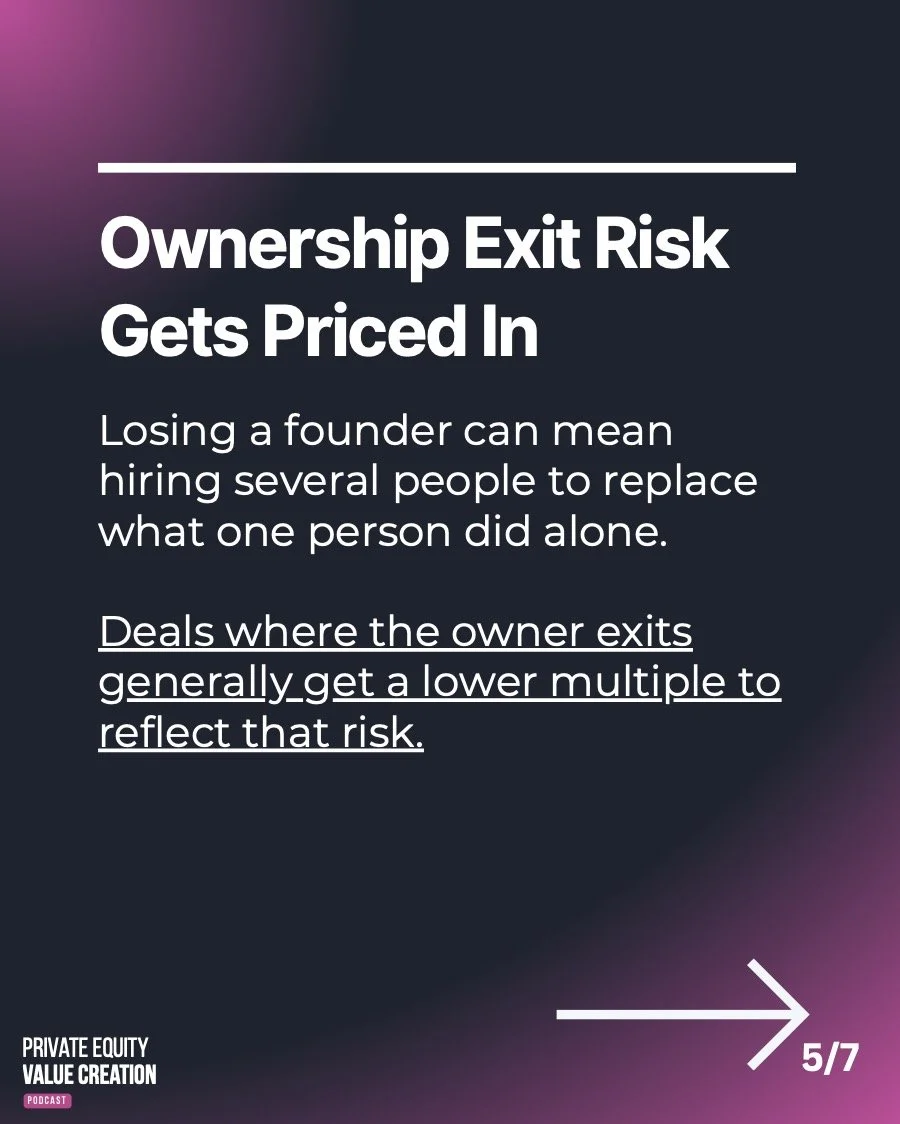
These owners know the business better than anyone after running it for 30 or 40 years. Managing that ownership transition is the single biggest risk when investing in closely held family businesses. The owner is often so involved that you might need to hire two or three people to replace what they were doing, and there's risk of losing customers or key employees.
We handle that transition with kid gloves. We support the owner and keep them happy as long as they want to run the company. When they're ready to step back, we work together to find the right replacement. Leadership transitions are an area where we and many other private equity groups have made mistakes in the past. Sometimes, if the first leader doesn't fit the organization, you have to bring in a second leader.
Shiv Narayanan: How much of the operational plan is led by the firm versus trusting the management team to execute on opportunities?
Sequoya Borgman: Our responsibility is big-picture strategy. We develop the strategic plan, but most management teams can only focus on one or two major initiatives at a time alongside day-to-day operations.
Each company will have one or two value creation ideas that we implement soon after investment—whether that's pricing, sourcing, or production. There's always low-hanging fruit or specific areas like customer concentration that we know will create value for the next buyer. Even if we have a list of ten items, we focus on the top two or three so we don't overwhelm the team right off the bat.
Professionalizing Legacy Businesses
Shiv Narayanan: In legacy industries like manufacturing and distribution, many functions need to be professionalized. How do you approach that process?
Sequoya Borgman: Finance is typically the number one area we focus on. We will often bring in a new CFO or a higher-level controller and implement new ERP systems. We do whatever is necessary to professionalize the business to prepare it for larger strategic buyers or upper middle-market private equity firms that don't want to do that heavy lifting themselves.
However, we execute this over three, four, or five years rather than trying to do it all in the first 90 days. Professionalizing systems, processes, and production takes time, and because people can be hesitant to change, key roles sometimes need to be replaced for changes to stick.
Shiv Narayanan: Upfront investments in process changes can temporarily slow things down. How do you evaluate that trade-off?
Sequoya Borgman: For every dollar spent, we require a clear return. We don't spend money on consultants, capital expenditures, or infrastructure unless we see a return on investment within two or three years. An ERP implementation, for example, is done because it has reached a critical point where the business is either losing opportunities without it or standing to gain significant upside.
The largest investments are often in new leadership teams. Strong leaders add direct overhead cost, especially if replacing one founder requires multiple roles. We bought a company where the owner was the primary salesperson, and we had to hire four or five salespeople to cover his output, costing more than he pulled out individually. Fortunately, the business grew to offset that.
When a business transitions from being run by a husband and wife to requiring a CFO, COO, CEO, and VP of Sales, that adds substantial cost along with new systems. Every dollar added must deliver a tangible return.
Underwriting, Leverage, and Risk Management
Shiv Narayanan: Tech or SaaS companies often have higher organic growth rates, whereas traditional industries may grow in the single digits. How do you underwrite investments when adding management headcount and overhead?
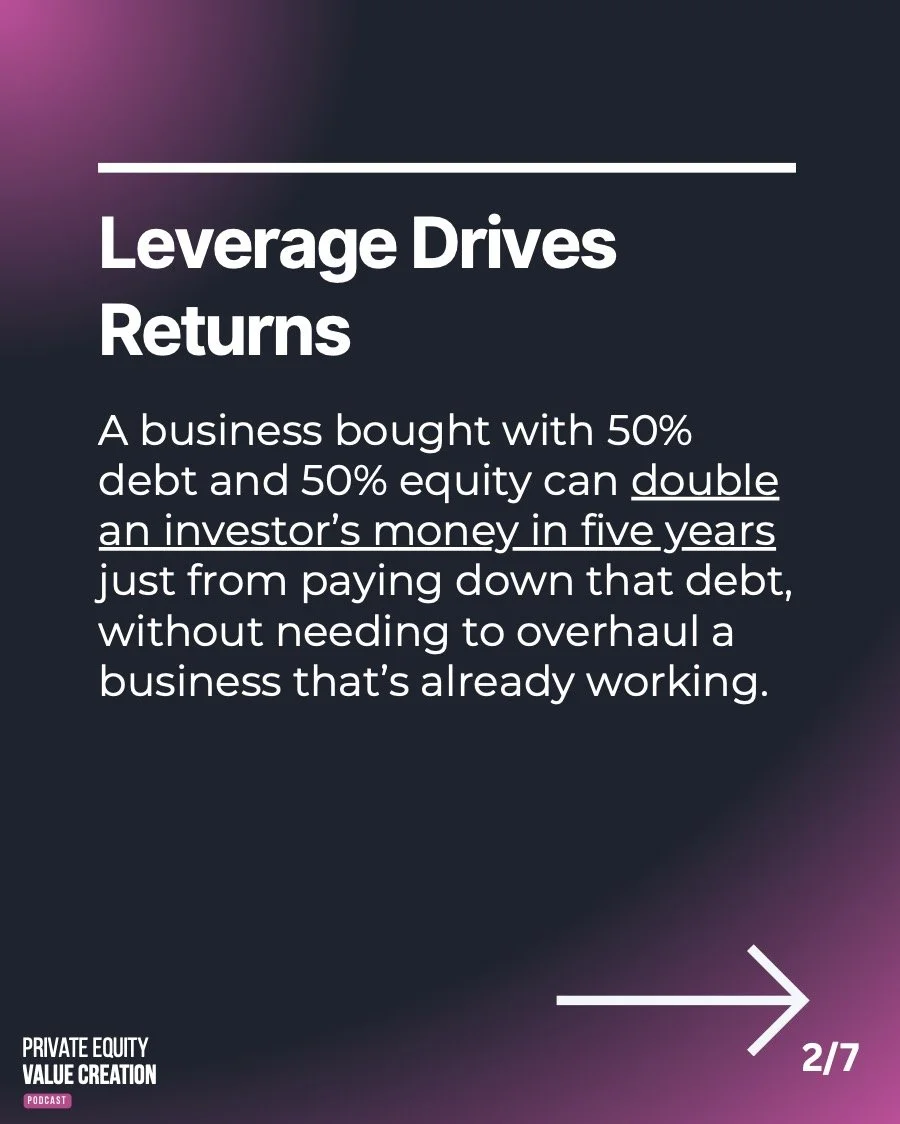
Sequoya Borgman: We don't need massive organic growth to achieve strong returns because of the way we structure leverage. If you buy a business with 50% debt and 50% equity and hold it for five years while paying off that debt, you double your equity investment without needing high growth, provided cash flow remains steady.
That is one of the primary benefits of the leveraged buyout model. If we can grow the business slightly through industry growth, inflation, and modest margin or cash flow improvements, we perform very well. It differs from SaaS or high-growth investing where there is little leverage and returns rely entirely on rapid growth. For us, maintaining what we bought and servicing the debt is a strong investment thesis.
Shiv Narayanan: In that model, managing downside risk becomes even more critical than driving hyper-growth. How do you protect against downside risk?
Sequoya Borgman: The primary downside risk is executing well-intentioned plans that negatively impact the management team, customer relationships, or productivity. In a leveraged deal, a reduction in revenue or margin compression poses a much bigger risk than the potential upside from aggressive operational changes.
Shiv Narayanan: How do you hedge against macro shocks or black swan events over long hold periods?
Sequoya Borgman: All our portfolio companies have navigated multiple economic cycles and black swan events over the last two decades. You have to focus on what is within your control. You can't prevent macroeconomic events like a pandemic or financial crisis, but you can prepare by deleveraging the business as much as possible. Excessive leverage is the biggest risk in LBOs, so we focus on strong fundamentals, sound business practices, and reducing debt.
Sales Transitions and Customer Concentration
Shiv Narayanan: In traditional businesses, revenue is often heavily driven by personal relationships, specific networks, or the founder selling directly. How do you transition a company away from founder-dependent sales to a predictable, institutionalized revenue engine?
Sequoya Borgman: The best way is to transition over time. We structure deals with seller rollover equity, earn-outs, or seller notes to keep founders aligned. We also keep them involved on the board and close to the business. If a customer issue arises, having the founder step in to assist with the relationship is invaluable.
We prefer taking two to three years to transition a founder out. Many founders in their 40s or 50s want to take some financial risk off the table while continuing to run the company, which presents lower risk.
Transactions where an owner wants to cash out entirely, retire, and step away immediately carry much higher risk. That risk is reflected in a lower purchase price multiple. We structure contingent notes in those deals so the seller shares in the risk if key customers or employees leave post-closing.
Customer concentration is handled similarly. Concentrated businesses receive lower valuations and less debt financing because of the risk. We go in clear-eyed and address concentration either through add-on acquisitions or by growing the remaining customer base to dilute that concentration over time. If you successfully transition those sales relationships or diversify the customer base, you capture significant upside.
Preserving Company Culture
Shiv Narayanan: How do you preserve the existing company culture when a founder transitions out?
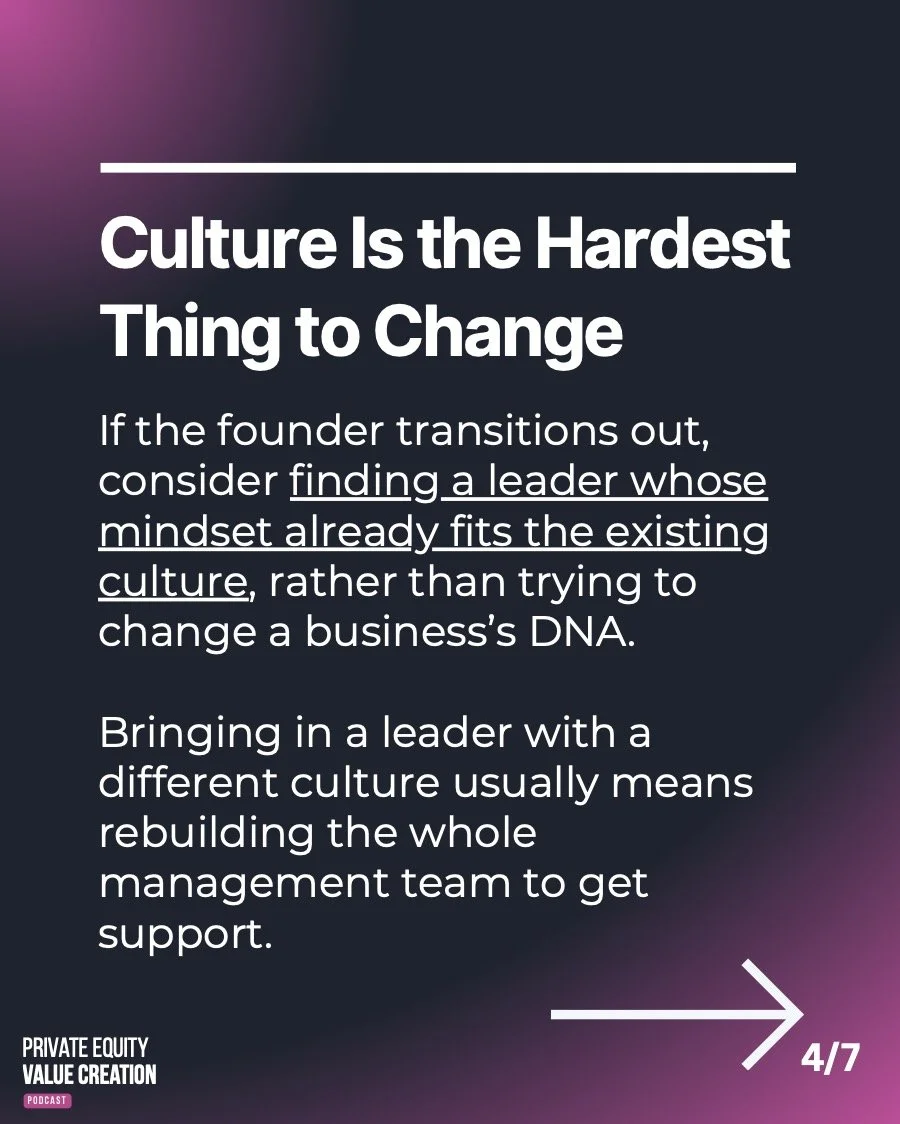
Sequoya Borgman: Culture is established early in a company's life and is very difficult to change. Rather than trying to overhaul an established culture, we seek incoming leaders who match the existing culture and mindset.
Bringing in a leader who fits the existing culture makes it much easier to gain the support of the remaining management team. Attempting to force a new culture often requires replacing the entire management team, creating a longer and higher-risk transition.
During initial diligence, I walk through facilities with the owner and observe the interactions. Does the owner know everyone's name? Are employees comfortable and happy talking with leadership? Those subtle details provide a clear picture of the organizational culture.
AI and Institutional Knowledge Capture
Shiv Narayanan: How do you view business continuity in the context of emerging technologies like AI?
Sequoya Borgman: In many lower middle-market businesses, the institutional knowledge lives entirely inside the owner's head. Very little is formally documented in systems or standard operating procedures.
AI tools offer strong opportunities to capture that institutional knowledge—extracting insights from owner emails and historical workflows to generate documentation, guidelines, and processes for the incoming management team. Because lower middle-market companies have limited bandwidth, we focus on practical AI applications that save resources and deliver clear operational value.
If you are a business owner considering private equity as an exit strategy, get in touch with us for a confidential conversation about your goals, your business, and to learn if our approach may be a good option for you. You may also be interested in the following resources: