
What to Expect When Selling Your Business to an Independent Sponsor
On this episode of M&A Talk, Jacob Orosz, President of Morgan & Westfield, speaks with Sequoya Borgman, Founder and CEO of Borgman Capital. The conversation explores the mechanics of the independent sponsor model and how it offers an alternative to traditional private equity for lower middle market business owners. Sequoya breaks down how deal-by-deal capital formation creates flexibility in hold periods, eliminates the pressure to deploy capital on a rigid timeline, and supports long-term business growth. He also shares practical advice for owners preparing their companies for sale, highlighting balance sheet discipline, cultural alignment, and executive succession planning.
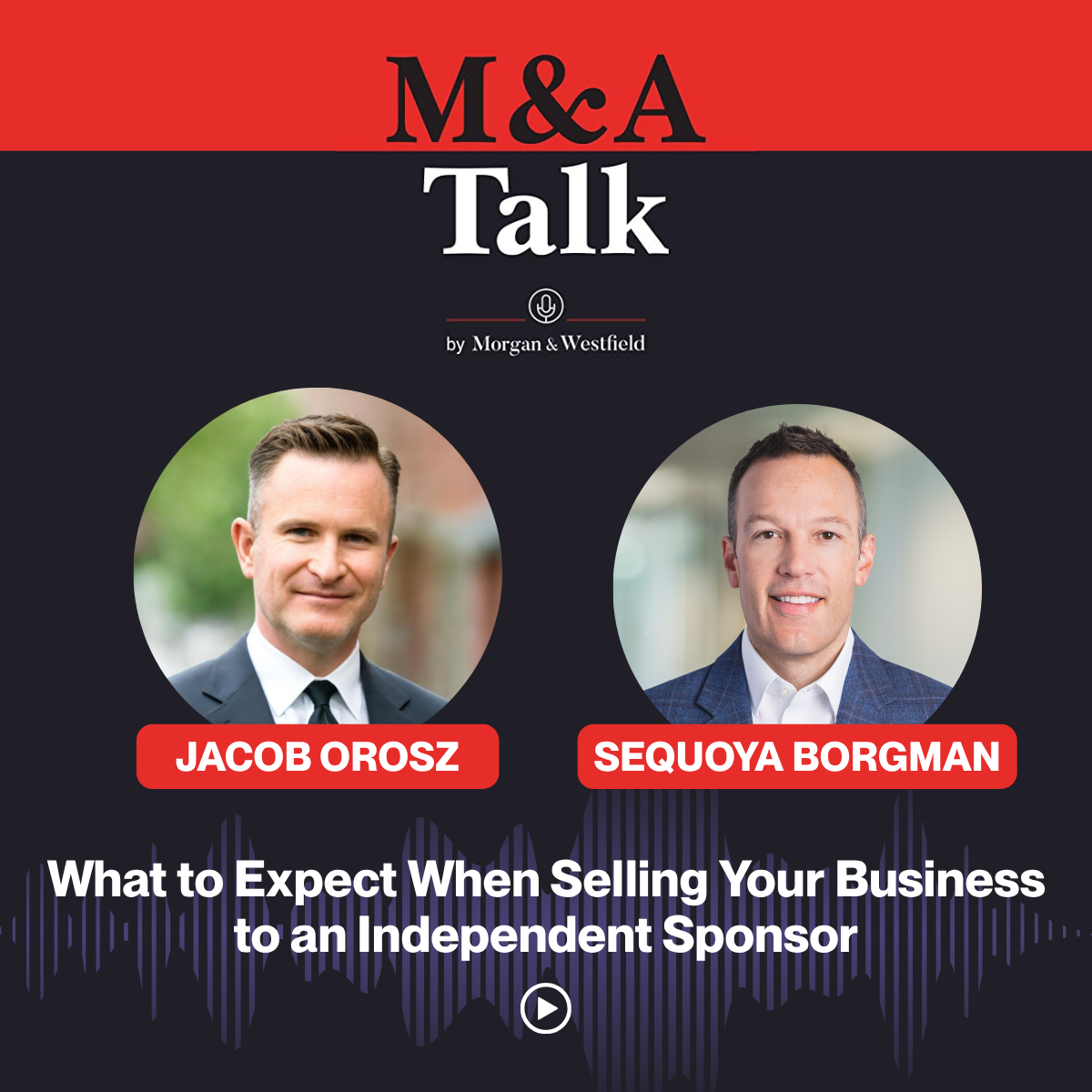
Listen to Sequoya Borgman explain how independent sponsors approach lower middle market acquisitions, patient capital, and seller partnerships.
Key Takeaways
Flexible hold periods support multigenerational value creation
Unlike traditional private equity funds constrained by a fixed 10-year lifespan and a mandate to exit within three to five years, independent sponsors raise capital on a transaction-by-transaction basis. This structural distinction eliminates forced exit timelines, allowing hold periods to span anywhere from three to 20 years. For lower middle market businesses with enterprise values between $20 million and $50 million, extended ownership allows value to compound over decades without disrupting operations or culture.
Disciplined underwriting stems from co-investment and the absence of deployment pressure
Without a committed fund that requires deploying hundreds of millions of dollars within a set window, independent sponsors can remain patient. Acquisition decisions focus strictly on whether a company represents a strong standalone investment. Conviction is reinforced by personal co-investment from the firm's leadership on every acquisition. Additionally, capital is presented to accredited retail investors and family offices only after initial diligence, quality of earnings reports, and bank financing terms are secured.
Evaluating buyer alignment is as critical as negotiating value
A business sale remains a partnership even when 100% of equity is transferred, as sellers frequently retain exposure through rollover equity, earnouts, seller notes, or ongoing leadership transitions. Owners should vet prospective buyers well before entering the LOI stage to ensure shared expectations regarding culture, employee security, and long-term legacy. Selecting a buyer whose vision aligns with the seller's goals prevents friction and supports continuity post-acquisition.
Multiyear exit preparation releases trapped balance sheet value
Preparing a company for sale requires planning over two to five years rather than a few months. Owners who systematically reduce excess working capital, manage inventory efficiently, and limit unnecessary capital expenditures retain that cash prior to sale. Because working capital pegs are typically based on historical averages, long-term balance sheet discipline directly increases net seller proceeds while making the company more attractive to buyers.
Questions Addressed in the Conversation
How does an independent sponsor differ from a traditional private equity firm?
Traditional private equity firms invest out of a committed fund structure with a 10-year lifespan, requiring them to acquire and exit businesses within strict timeframes. Independent sponsors raise equity for each acquisition individually. Established independent sponsors maintain identical institutional infrastructure, diligence standards, and back-office operations as traditional funds, but operate without fund mandates or fixed hold periods.
Why do long transition overlaps between founders and incoming CEOs often fail?
Long transition overlaps frequently create friction because two strong leaders end up competing for authority within the business. A shorter overlap of three to six months is generally more effective. Involving the outgoing founder in candidate interviews helps assess cultural fit and ensures the founder supports the new executive's authority.
How are executive leadership teams compensated in lower middle market acquisitions?
Compensation packages typically pair a lower base salary than corporate peers with substantial, uncapped incentive structures. Sponsors often allocate around 10% of transaction equity to management teams, earning out based on annual enterprise value growth. This structure rewards entrepreneurial leaders and aligns management, sponsor, and investor returns around long-term growth.
From the Conversation
“Technically, we’re buying businesses, but all these businesses are collections of people built over a long period. You want to invest in businesses with people you trust, who are aligned with you and who want what’s best for the business.”
-
This transcript has been edited for clarity and readability. Please refer to the original podcast recording for the complete conversation.
Podcast Introduction
Jacob Orosz: Today we’re going to talk with Sequoya Borgman. He is the founder and CEO of Borgman Capital and an independent sponsor. If you own a small to mid-sized company with, I’d say, $1 million to $15 million in EBITDA, an independent sponsor is a likely potential buyer of your company. If you don’t know what an independent sponsor is or how one operates, this show is for you. Sequoya, welcome to the show.
Sequoya Borgman: Thanks for having me on.
What Is an Independent Sponsor?
Jacob: Let’s dive right in. If you own a middle market or lower middle market company, you may encounter what’s called an independent sponsor as a potential buyer, very similar to a private equity firm. You are an independent sponsor. What is an independent sponsor?
Sequoya: I can tell you a little about the differences. Traditionally, they were called fundless sponsors. Really, it’s anybody sponsoring the acquisition of a business who is not doing it through a committed fund structure.
Traditional funds have a 10-year structure. You buy three to 10 businesses over that period, and then you have to exit and return the money to your LPs. In an independent sponsor model, you raise the money for each acquisition. If you’re buying a business, you raise the money just for that one deal. It’s similar to a fund, but there is no life on that investment. It could be three years or 20 years before you exit a business. It’s a lot more flexible.
It’s become a much more popular structure over the last decade. The independent sponsor model has really grown, and there are a lot of independent sponsors out there these days.
Jacob: How is it different from a private equity firm, just to really clarify that for listeners?
Sequoya: With more established independent sponsors like us—we’ve bought 20 companies, been around almost a decade, and have 13 people on the team and three offices around the country—there’s really no difference between us and a committed lower middle market fund. We have the same fund administration, back office and processes. The value creation plans are very similar.
The only difference is that we have the flexibility of not having one fund mandate. We can be more opportunistic and pursue good investment opportunities that may not be right down the middle of what a fund would be required to do. Our hold periods can be longer, too. A lot of business owners don’t want to sell to someone who is going to flip their business in two or three years and be that disruptive to their people.
As I said, we can hold for 10 or 20 years. It’s similar to a family office investment model with a long horizon. A lot of the wealth built by investing in lower middle market businesses is created over decades or generations, not over two or three years. A longer hold really resonates with a lot of sellers.
How Independent Sponsors Raise Capital
Jacob: How many investors do you usually bring in on each deal? What’s the typical range?
Sequoya: It really depends on the size. We’re kind of a retail investor shop. Most of our LPs are family offices or high-net-worth individuals. We may have 80 to 100 investors in a larger deal and fewer in a smaller deal. About 500 LPs have invested with us over the life of our firm.
Jacob: On a typical deal, do you send it to all 500 investors and say, “Here’s the deal we have. Who wants to invest?” What does that process look like on your side?
Sequoya: Once we get something under LOI and have completed the initial diligence around the numbers and the Q of E—quality of earnings report—and received good term sheets from banks, we send it to our investor group. We conduct one-on-one meetings or a webcast to walk through the investment thesis and see what the interest levels are.
We also have a proprietary retail investor platform, similar to real estate, angel or venture platforms, where investors who want access to these types of deals can sign up and get on the list. It’s called Pass the Hat. Anyone participating must be an accredited investor in the U.S. If you want access to traditional, established lower middle market leveraged buyouts, we have that platform.
Deal Size and Capital Structure
Jacob: What size deals are you doing?
Sequoya: The typical enterprise value is probably between $20 million and $50 million. That might include $10 million to $30 million of equity, with the rest made up of mezzanine or subordinated debt and traditional bank financing. Seller notes and earnouts are also much more popular these days, given the current deal environment.
Jacob: So, roughly $3 million to $7 million in EBITDA?
Sequoya: I’d say $3 million to $15 million is about the size we work on—typically under $20 million.
Jacob: What’s the capital structure? You mentioned it, but let’s talk about it some more.
Sequoya: We’re pretty conservative investors, and we invest in traditional industrial and food businesses. These businesses have been around a long time. They aren’t technology, high-growth or newer-industry businesses. We’re paying lower multiples and putting less debt on them—traditionally, maybe two to four times leverage—with the rest in some type of equity structure.
Jacob: On a $50 million deal, what might that look like? How much debt, seller note and so forth?
Sequoya: It depends on the multiple we’re paying, but on a $50 million deal, we might have $20 million of equity, including transaction costs, and $30 million in debt—perhaps $20 million in a senior note with a bank and $10 million in seller note or mezzanine financing.
Jacob: How do you structure it with investors from a legal standpoint? Do they all join together in one entity?
Sequoya: It’s like investing in a fund. We set up a separate investment vehicle just for that transaction and register a Reg D filing. If we have 100 investors in that fund, they invest at the LP level, but it is only for that particular investment. It’s not for future investments, and there are no future commitments. That LP then invests in the operating business or holding company we’re buying.
Add-On Acquisitions and Investor Involvement
Jacob: If you’re buying a platform, how do you handle add-ons or tuck-ins?
Sequoya: Traditionally, we don’t get commitments for those up front because they’re hard to time. We’ve done plenty of roll-up opportunities, but you could have three opportunities in one year or none for three years.
Jacob: Is that the same fund, or would it be a new set of investors?
Sequoya: Normally, we send it to the same investors and give them the opportunity to avoid dilution by reinvesting in the next round. If it’s a larger add-on and we need outside investors, we open it to them, but current investors get the first look.
Jacob: Do investors have any say in the deal structure or diligence? Do they get involved or interface with the deal, or is that all behind the scenes?
Sequoya: We traditionally have an anchor investor who conducts full diligence, digs into the data room, interacts with management and attends management meetings. They may have a board seat as well.
Why Sellers Consider Independent Sponsors
Jacob: What are some other differences between an independent sponsor and a private equity firm?
Sequoya: I think the value of independent sponsors is that we have no pressure to deploy capital. We don’t have a fund sitting there that requires us to deploy $500 million, $750 million or another set amount over a certain period. We can be very patient. I personally invest in every company we buy, and my partners invest in every company we buy. We only have to buy something if we feel it’s a great investment for ourselves personally. That lack of pressure to deploy capital is one big difference.
We’ve been pretty active because we’ve come across good opportunities in the space. Independent sponsors also tend to focus more on proprietary, off-market deals where we negotiate directly with the seller. We spend a little less time in auction processes than a fund might.
We have to resell these investments to our investors. We have an investment committee that meets every Monday, of course, but once we’re convinced it’s a great investment, we still have to convince our investors. With a committed fund, once the investment committee thinks it’s a great investment, that’s the end of the decision process. We have to consider how our investors will view the opportunity.
If it’s a blind auction process, there are a lot of buyers for those businesses.
Jacob: So, it’s more competitive.
Sequoya: Yes, it’s more competitive. I’m not saying we’re paying less than we would in an auction process; it’s just where we tend to focus our time. Every transaction, management meeting, LOI and IOI process involves travel and diligence costs. If you don’t have a high likelihood of winning, those costs add up. You want to focus where you have the best odds of winning.
Jacob: How do you pay your expenses if there’s no fund generating a 2% management fee?
Sequoya: My wife asks me that all the time. It comes out of our pockets. If a transaction is successful and we get to the closing line, we charge a closing fee. That covers much of our diligence costs, overhead, insurance, staff and related expenses. That’s where most of those fees come from.
Jacob: How often do you find a deal but can’t get the equity because there are no investors? How common is that?
Sequoya: Fortunately, knock on wood, we’ve never had that happen. A decade ago, when we were launching, the first deal was harder to raise money for. Since then, every deal has been oversubscribed.
My partners and I are now some of the largest investors in the deals, since we’ve had liquidity. A lot of the money we receive back rolls into future deals. Last year, we did three acquisitions. I was the largest investor in one and the second-largest in another. We have large commitments, and nearly 500 investors have invested with us at this point. People want access to these attractive lower middle market direct investments.
Working With Portfolio Companies
Jacob: How involved do you get in operations once you acquire a company?
Sequoya: We’re very involved—sometimes more than I would like. Lower middle market companies, and all of our companies are under $200 million in sales, don’t have a lot of resources or large departments that handle every little thing. We help as much as we can.
We aren’t micromanaging the management team. We hire good leaders and expect them to do what’s best for the business, but we’re very involved in strategy and bringing in outside resources. We try to share best practices across all portfolio companies. Every month or two, we bring the presidents and management teams together to share what’s going on. Tariffs have been a big topic recently. If you’re a $100 million or $50 million business, you don’t usually have those types of resources to call on, and that’s what we’re there for.
Jacob: How many companies are in your portfolio now?
Sequoya: We have eight platforms right now, and we’ve bought 20 companies since we launched. We’ve exited three platforms to date.
Advice for Business Owners Preparing to Sell
Jacob: What’s your number one piece of advice to sellers when it comes to preparing their company for sale?
Sequoya: There’s a lot of advice, and you’re probably better at advising sellers. We look at so many businesses, and the ones we like most are owned by people who really care about their businesses, employees and legacy, and who want the company to continue to thrive and be successful. Then we know our investment is going to do well.
At the end of the day, we are responsible for getting the best return on our investment, and that’s our focus. But when you find a seller who is aligned and has the same incentive, those are the best opportunities. I’d say: Find a buyer you’re truly aligned with. It is a partnership.
Even if you’re selling 100% of the equity, you’re still going to be involved in some way. Maybe there’s a seller note or earnout, or maybe you care about the employees. You don’t want someone to come in, replace your entire team or change a lot of what you’ve taken decades to build.
Make sure you’re aligned, and don’t focus only on structure and value. Of course, it’s hard not to take the largest check, and I’m not saying you shouldn’t. But make sure you vet the buyers before entering even the IOI or LOI stage. Make sure both parties are comfortable that it’s right for them.
Jacob: Solid advice. Let’s take a quick break, and we’ll be right back.
Seller Transitions and Leadership Succession
Jacob: Sequoya, to what extent do you require the seller or owner to stay involved in the business?
Sequoya: Unlike some firms, we don’t require them to stay involved or roll over a percentage of equity. It does align interests, though. I’d say 80% of the time, the seller rolls over about 20% of the equity—maybe a little more or less. The usual transition period is six to 24 months.
Most sellers we buy from are family businesses or entrepreneur-led businesses that don’t have a successor. That’s known up front, and we work with them to find someone who is a cultural fit and can step in to lead the business within a certain period.
I find that longer overlaps traditionally don’t work very well. When you have two type-A leaders trying to run a company, they tend to butt heads. I prefer a shorter transition period—perhaps a three- or six-month overlap—depending on the situation.
Jacob: What’s your strategy for finding a new CEO?
Sequoya: I was just talking to someone who does that for us, and they said the success rate is around 50%. I’d say we’ve probably had similar success. You vet many candidates, interview them, have the boards interview them and conduct personality profiles, but you never really know whether someone will fit a particular business until after they start.
We have the previous owner and founder interview them and provide input. They know the culture better than we will on day one. They tend to be more supportive of someone they helped select than of someone you try to force on them, which doesn’t work very well. I’ll be the first to admit we’ve had to replace more presidents than I would like.
Executive Compensation and Incentives
Jacob: What does a typical compensation package look like for a company in the lower middle market?
Sequoya: Our typical package may have a slightly lower base than a president would receive running a division of a larger or public company, but a higher incentive component. Most of our incentive compensation isn’t capped. If they grow enterprise value annually, their incentive compensation can be a multiple of their base.
We usually set aside about 10% of the equity for the management team to earn if they hit annual enterprise value growth targets. A significant portion of equity is set aside for the management team, and that can be significant on these size deals. That’s why we look for someone entrepreneurial who is willing to take a risk on themselves and is ultimately in it for an exit. That aligns their interests, our interests and our LPs’ interests.
Family Offices and Search Funds
Jacob: How would you differentiate yourself from a family office?
Sequoya: I would say the resources. We have more resources than most typical family offices. Family offices also tend to make more passive investments. We’ve been control investors in every deal we’ve done; we aren’t minority or passive investors. We’re responsible for a lot of people’s hard-earned money, so we need some type of control and to be in the GP position.
Many family offices invest with us, and they’re welcome to sit on the board and help with the investment. From my standpoint, the more help, the better. Some larger family offices are now building full private equity teams, conducting diligence and value creation, and adding operating partners. But that’s the key difference with smaller, more passive family offices.
Jacob: What about search funds? They’re typically doing somewhat smaller deals, but what’s the difference for listeners?
Sequoya: I love search funds. I wish I had known about them when I was in college a long time ago, but they really weren’t a thing. Search funds are usually led by newly minted MBAs who have about a year or two to find a business. They’re very aggressive, talk to many business owners and stumble across great opportunities. If an opportunity is too large for them to complete with their backing, I’d love to partner with them.
Deal Process, Diligence and Timing
Jacob: What does your deal process look like, and at what stage do you involve investors? It sounds like you complete the Q of E before involving them. What else do you do before introducing the opportunity?
Sequoya: We want to be very confident that the capital stack is laid out. That includes term sheets from banks, the Q of E and initial diligence. If the business has risk areas, we want to make sure we’ve done that diligence. Of course, much of the legal and other diligence will occur later in the process.
Jacob: But you prioritize it based on the risks.
Sequoya: Exactly. Usually, you know the risks in that industry. Maybe it’s environmental. We’ve bought chemical distribution businesses, and environmental diligence tends to extend the deal timeline. We don’t want to take something to investors, obtain commitments and then have to go back and change the terms. We also never call funds until we’re confident we’ll close under those terms. We wouldn’t want to return money to investors.
Jacob: What’s your typical time frame?
Sequoya: It’s longer these days than it was a couple of years ago. At that time, deals were closing in 60 or 90 days, and we closed several in 60 days. In the current environment, it’s much slower. The typical timeline is probably 90 to 120 days.
Jacob: What has contributed to that? What slowed it down?
Sequoya: There isn’t the deal frenzy we had several years ago. There are fewer buyers and sellers in the market. I’m not saying anyone cut corners on diligence, but people are much stricter about the diligence process. Multiples are down slightly, but the banks are really driving it: They’re putting less leverage on businesses. There are more earnouts and seller notes, so negotiating those parts of the transaction takes more time.
Jacob: You get term sheets from the bank before taking the opportunity to investors, right?
Sequoya: Yes. We’ve usually selected a bank by the time we go to investors, or we have a very good idea of the terms.
Jacob: At what stage do you get a commitment letter from the lenders or debt providers?
Sequoya: Usually about a month into the process—about 30 days. In the first week or so, as soon as we can put together a bank package, we send it to lenders. We talk to mezzanine providers on the same timeline. About 30 days in, we receive a commitment and decide whom to move forward with. They then have about 60 days for site visits and diligence. Depending on the size of the institution, they may bring in outside diligence providers.
Understanding Mezzanine Debt and Unitranche Financing
Jacob: What is mezzanine capital, for those who don’t know?
Sequoya: It’s subordinated debt. It sits above the equity but below the senior lender—the traditional commercial bank. It carries higher rates and sometimes includes equity or warrants in the transaction.
Jacob: So, primarily debt with an equity kicker.
Sequoya: Sometimes. There are many different mezzanine structures. On some smaller deals, we’ll provide our own mezzanine debt if our investors want a slice of current-paying mezzanine debt. On larger deals, we bring in larger mezzanine funds or unitranche investors.
Jacob: What’s the difference between senior debt and mezzanine debt in terms of cost?
Sequoya: Mezzanine rates are usually six or seven percentage points higher than traditional senior lender rates.
Jacob: And there’s an equity kicker on top of that?
Sequoya: Not always, but sometimes there is a warrant, or they invest traditional equity alongside our LPs.
Jacob: Who are the mezzanine providers?
Sequoya: They’re funds. SBIC funds receive some of their backing from government financing, so they traditionally have pretty good rates on mezzanine financing. There are also many retail funds that provide financing. A lot of them want to do unitranche, which combines the senior debt and mezzanine debt.
Jacob: Blended into one.
Sequoya: One blended rate, yes. Instead of working with a commercial bank and a mezzanine fund, you can use one provider.
Jacob: What’s unique about your deal structure compared with private equity firms, family offices or strategic buyers?
Sequoya: I’m not sure our deal structure is unique. The terms are pretty standard across the industry. I’d say we’re a little more conservative, so we may put more equity into a deal, over-equitize it or close a transaction with some cash on the balance sheet.
Other lenders—or other investors—are sometimes much more aggressive. They push the envelope on leverage because that helps returns. We’re probably less likely to do that.
Acquisition Criteria and Growth Strategies
Jacob: What’s most important to you in terms of acquisition criteria?
Sequoya: Buying from a seller I really trust and with whom we’re aligned is the number one thing. At the end of the day, you’re investing in people. Technically, we’re buying businesses, but all these businesses are collections of people built over a long period. You want to invest in businesses with people you trust, who are aligned with you and who want what’s best for the business.
Jacob: What’s your growth strategy? What’s the toolkit you pull from?
Sequoya: Fortunately, private equity has many tools. People call it financial engineering, but a lot of your return comes from leverage. Not every business needs an aggressive growth strategy. If you buy well at a lower multiple and pay down the debt, you can double your money.
With other businesses, you have to grow if you’re paying up for them. Those tend to be businesses that are already growing. If they have a high year-over-year CAGR, you want to maintain or increase it, and that requires a different strategy.
Then there are roll-up strategies, where you buy companies at lower multiples than your platform. That adds some accretion to the investment. Multiple accretion is less meaningful these days, though. Multiples aren’t increasing as they did over the last decade; they’re flat to down.
Jacob: What’s the biggest mistake you see sellers make?
Sequoya: The biggest mistake is probably not taking the time to get the business ready for sale. It takes years—sometimes two, three or five years. Many sellers think about selling for a decade, so they have the time. Others reach a point in life when they’re ready, pull the trigger, hire an investment banker and sell within six or nine months.
That’s probably the biggest mistake: not taking the time to prepare. It’s no different from staging a house before selling it. You’ll attract more buyers and interest and get a higher price if you prepare the business.
Also, focus on the balance sheet. One simple step is to reduce working capital as much as possible. All that cash goes into your pocket when you sell. Don’t sit on excess inventory.
Jacob: That’s a big one. Leaning it down can put millions of dollars in your pocket. I’ll have an article on net working capital for those who don’t know. How much do you think an owner can save by leaning it down?
Sequoya: They can save a lot. It depends on the size of the business, but it’s straightforward, low-hanging fruit. Most transactions have a working capital peg, probably based on a 12-month average. There are many ways to approach it, but if you work it down for only one year, you won’t get much benefit. If you reduce it over two years or longer, all that cash is sitting in your pocket.
The same applies to CapEx and any other expenses you don’t truly need to incur before the transaction.
Jacob: How do you factor CapEx into the valuation?
Sequoya: It affects valuation. You’ll pay a lower multiple for a company with high CapEx. Really, we’re buying a stream of cash flow. If the business requires significant maintenance or CapEx each year, that stream of cash flow is lower, which is why those businesses trade at a lower multiple.
Jacob: As we wrap up, Sequoya, what do you think is the most important takeaway for listeners?
Sequoya: Consider independent sponsors when you’re thinking about selling. I think that’s the big one.
Jacob: There we go. Simple enough. That’s Sequoya Borgman, founder and CEO of Borgman Capital. We’ll have his contact information in the show notes. Sequoya, thanks again for joining us on the show.
Sequoya: Thanks for having me.
Hear More on the Independent Sponsor Model and Lower Middle Market Value Creation

If you are a business owner considering private equity as an exit strategy, get in touch with us for a confidential conversation about your goals, your business, and to learn if our approach may be a good option for you. You may also be interested in the following resources: